It’s a Good Thing the F-35’s $400K AR HMD Helmet Is Stupid Cool
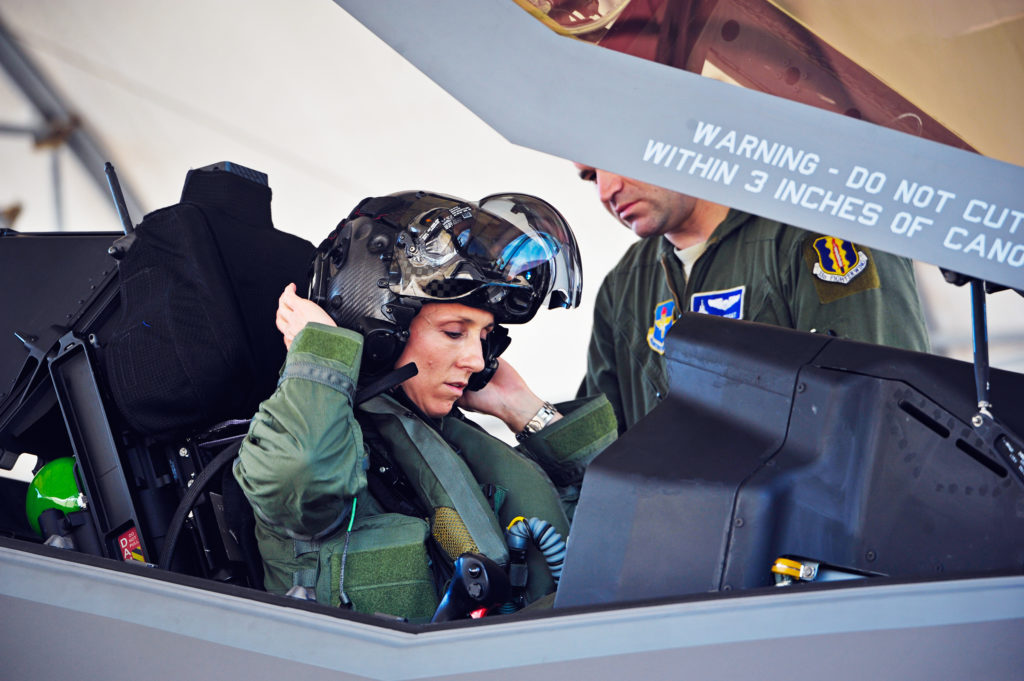
Lt. Col. Christine Mau, 33rd Operations Group deputy commander, puts on her helmet before taking her first flight in the F-35A on Eglin Air Force Base, Fla., May 5, 2015. Mau, who previously flew F-15E Strike Eagles, made history as the first female F-35 pilot in the program. (U.S. Air Force photo/Staff Sgt. Marleah Robertson)
The pilot can see through the base and walls of the aircraft, thanks to six cameras mounted outside the F-35. The “Distributed Aperture System” provides a 360-degree view of the plane’s surroundings, stitching together feeds from the corresponding external cameras based on where the pilot’s looking. It labels objects in her field of view with distance, bearing, speed, and altitude.
If the pilot feels that something she sees should be hit by a missile, or just wants a closer look, all she has to do it look at it to lock on, then flip a switch to zoom in, or fire away. Even when she’s looking elsewhere, the plane’s sensors are constantly looking for threats and keeping track of nearby wingmen, projecting relevant info onto the inside of the helmet’s visor.
...helmet-mounted displays since the 1980s. The key difference with this dome protector is the way it collates and visualizes info from all the plane’s systems.
See the full story here: https://www.wired.com/2016/06/course-f-35-comes-400000-augmented-reality-helmet/
Univ of Washington Students demonstrate their HoloLens apps after a quarter of VR and AR design
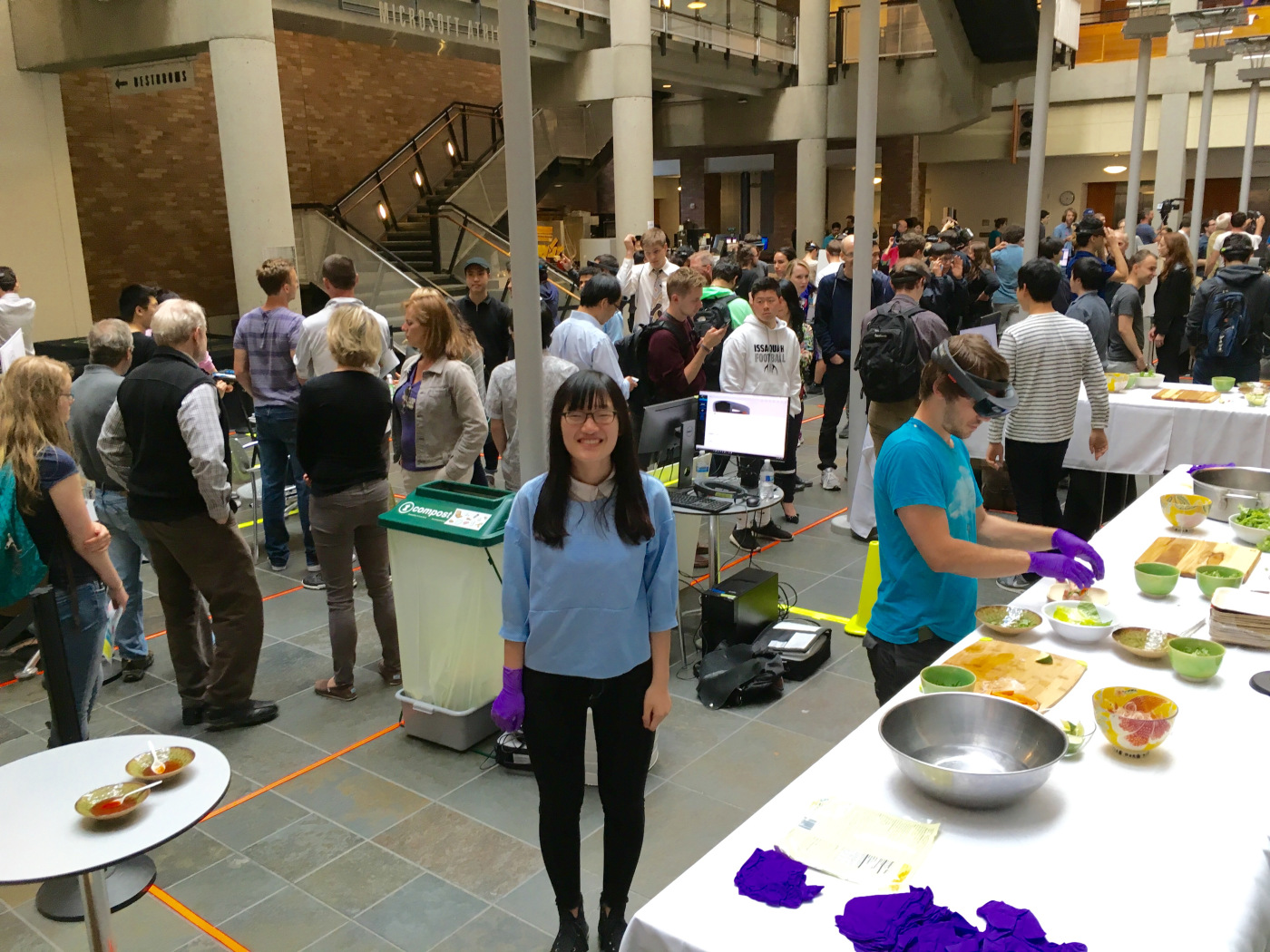 It’s just about impossible to get your hands on Microsoft’s impressive mixed-reality HoloLens platform these days — unless you’re a computer science student at the University of Washington. Then you get to play with them whenever you want.
At least that’s the case for the students in CSE 481V, in which, according to the course description, you will “learn a ton about Virtual and Augmented Reality, get familiar with the latest technology and software, and build an app in 10 weeks.”
This is the first time the course has been offered in this fashion, with generous underwriting by local VR/AR players Microsoft, Oculus and Valve/HTC. The 36 students in the course had access to the HoloLens dev team and all the major headsets — there were 25 HoloLenses involved, which is probably more than have ever been in one place.
The class culminated in a sort of open demo day at the UW campus, where students could show off their work to the general public and serious players like Microsoft Research’s CVP Peter Lee.
See the full story here: http://techcrunch.com/2016/06/10/students-demonstrate-their-hololens-apps-after-a-quarter-of-vr-and-ar-design/
‘Heroes’ star and ‘Lion King’ music producer invest in Limitless virtual reality character startup
 Limitless, a virtual reality startup created by a former Pixar and Bungie character designer, has closed its first round of seed funding from investors including music and film producer Jay Rifkin, who worked on “The Lion King” film’s original score; and Masi Oka, a game startup leader and former Industrial Light & Magic digital effects artist better known as the character Hiro from the NBC series “Heroes.”
Limitless debuted its technology at the Game Developers Conference (GDC) in San Francisco, along with a VR experience produced on its platform by the company’s first publicly-announced customer, the VR film company Motional. In the experience, a character named Gary the Gull asks questions and, using Limitless technology, understands user responses, reacting based on a preset script, depending on what users say and do.
See the full story here: http://www.geekwire.com/2016/limitless-vr-character-platform-closes-805k-funding-round-heroes-star-masi-oka-investor/
Augmented reality in the enterprise – moving from pipe dream to use cases?
 For Hand, building a good AR business cases involves three steps:
- Proving the bottom line – compare the new AR process with existing one – how will it save resources and time?
- Tell a story the business can understand – give the business a story from the point of view of the service tech or factory worker, describing how their job will change for the better.
- Demonstrate the tech in action – show the business and service techs the technology. Demonstrate it in action to show the ease of learning/ramp-up.
What are the barriers to AR adoption?
The panel acknowledged barriers to adoption. Jay Wright, SVP and GM Vuforia, asserted that the technology is ready. Hand, thinks the AR tools are ready for pilots now. But VR tools aren’t ready yet. Vuforia Studio supports VR, but Hand sees a “lack of really good VR tech.”
VR/AR, he says, needs to be as unobtrusive as a pair of glasses, rather than a bulky distraction to those wearing the gear (and those around them). He’s “eagerly awaiting” better VR tech.
Culture change is another barrier. Hand pointed out that “cool” technologies can create their own barriers to acceptance.
See the full story here: http://diginomica.com/2016/06/08/augmented-reality-in-the-enterprise-moving-from-pipe-dream-to-use-cases/
Virtual Reality Actually Feels Real When It Uses Physics
 [Philip Lelyveld comment; Oculus Rift with Leap Motion allows you to pet a virtual dog. The Nintendo 3DS had a simpler version of this that let you pet a dog with a stylus 4 years ago.]
Midas Touch made this work by building software meant to properly mimic physics in virtual reality. In the case of the dog demo, for instance, it models the input device (my bare hands) as different bones that can collide with the dog. The dog, too, is modeled with 20 to 30 bones that have mass, shape, and friction, which can collide with my hands. When my hands move around, the software figures out how the two are striking each other and uses the force of that impact to figure out which muscles to tighten on the dog so it can keep its balance while I’m, say, pushing its legs.
Evan Suma, a research assistant professor who studies virtual reality at the University of Southern California’s Institute for Creative Technologies, agrees, saying that Midas Touch Games is getting at one of the key things needed for VR to give a sense of presence: the illusion of plausibility.
See the full story here: https://www.technologyreview.com/s/601618/virtual-reality-actually-feels-real-when-it-uses-physics/
The first phone with Google Tango is a 6.4-inch monster from Lenovo
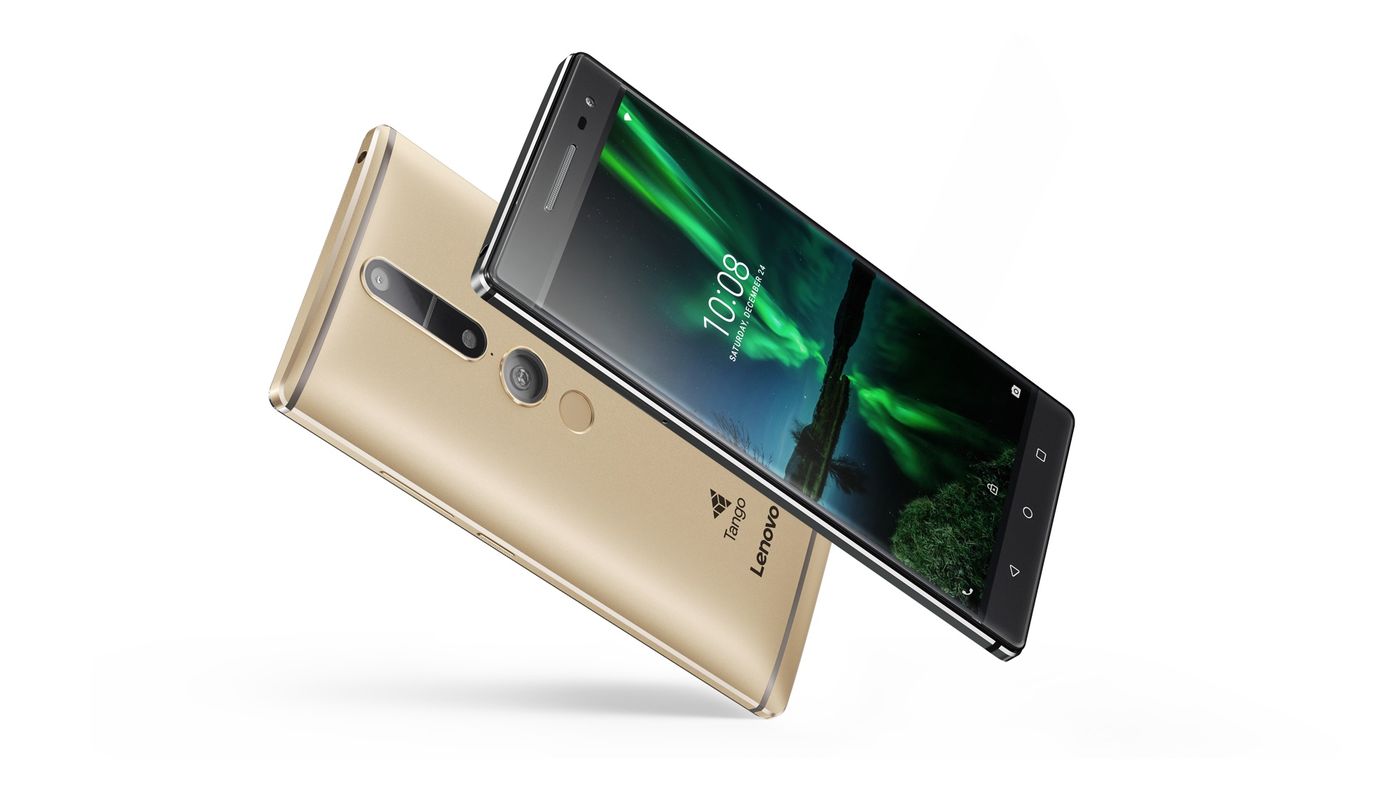
 Lenovo is today announcing a new range of smartphones that will be coming to the US later this year. The Phab 2 and Phab 2 Plus are updates of last year's Phab model and feature oversized 6.4-inch displays, metal construction, and low prices. But the most interesting member of the range is the Phab 2 Pro, which is the first consumer device with Google's Tango augmented reality technology.
The Phab 2 Pro is like the other Phab 2 models in that it has a very large 6.4-inch display and similar physical design. The Pro's screen is quad HD and the phone is powered by Qualcomm's Snapdragon 652 processor (as opposed to the MediaTek chips in the Phab 2 and Phab 2 Plus). It has a 16-megapixel camera, 4GB of RAM, a fingerprint scanner, 4,000mAh battery, and all of the other features you'd expect on a modern Android smartphone.
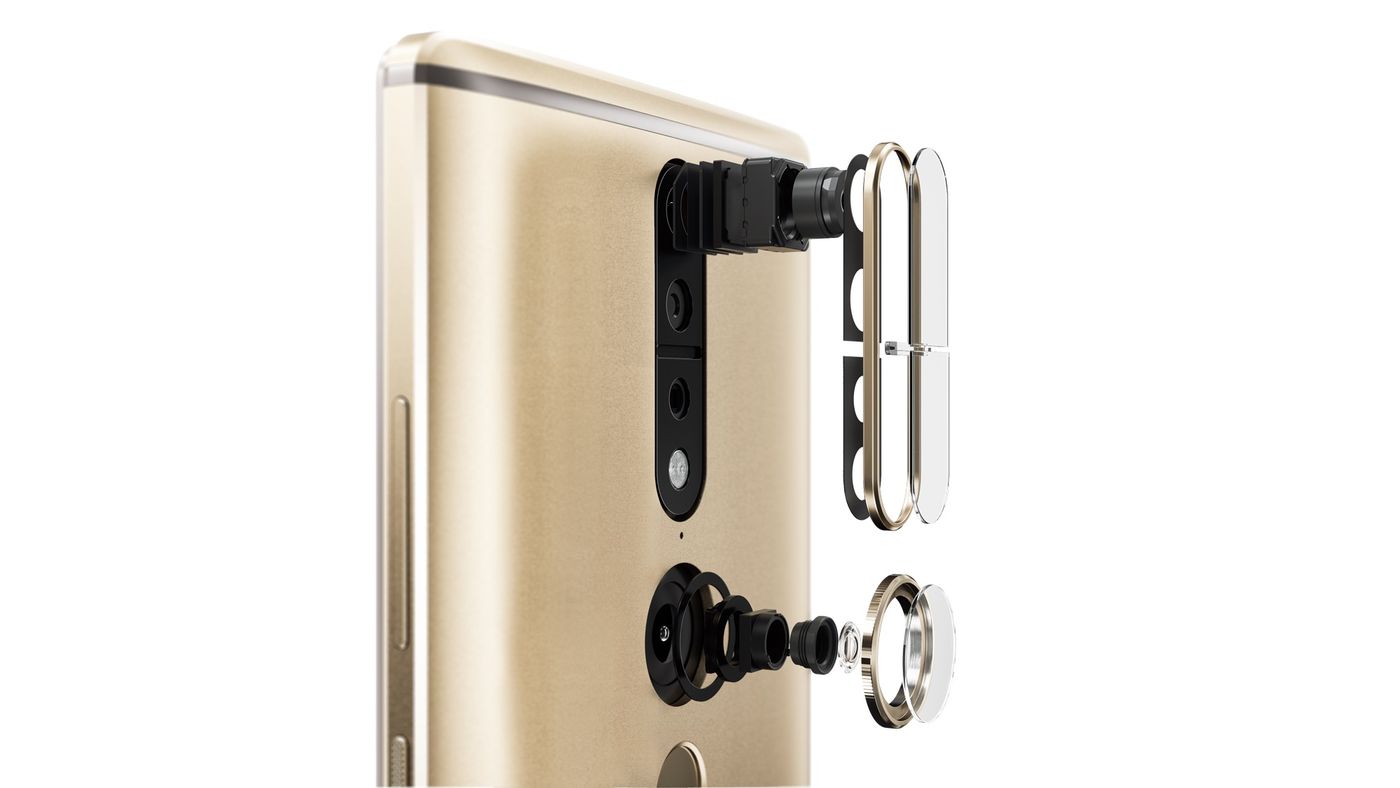
 But what sets the Phab 2 Pro apart is the Tango technology, which adds a wide-angle camera and special depth-sensing unit to the main 16-megapixel shooter. It's a shrunken down and improved version of the Tango camera array that's been available to developers in a tablet device for a couple of years, but it largely functions the same way.
Using the Tango features, the Phab 2 Pro can map out a physical space, track objects, and project virtual effects in a real-world space. Lenovo is demonstrating the technology with a variety of apps, including virtual reality-style shooting games; an educational app, made in partnership with the American Museum of Natural History; and a domino app that lets you set up Rube Goldberg-like contraptions with virtual pieces. Prior Tango demos have shown how it can be used to navigate an indoor space or provide contextual information based on the object it is looking at.
You'll be able to get the Phab 2 lineup directly from Lenovo and select retailers in September. The Phab 2 will cost $199, while the Phab 2 Plus will sell for $299 and the Phab 2 Pro will retail at $499.
See the full story here: http://www.theverge.com/2016/6/9/11882514/lenovo-phab-2-plus-pro-tango-google-specs-announce-smartphone
Additional background here: http://www.theinquirer.net/inquirer/news/2440948/intel-realsense-and-google-project-tango-smartphone-is-on-pre-order-for-usd399
Also see video at http://www.pressherald.com/2016/06/08/new-smarthone-opens-door-to-augmented-reality/
Phil Lelyveld’s APEX Tech Airline Passenger Assoc. talk
 Considerations on Using Virtual and Augmented Reality in Flight
Phil Lelyveld, program manager of the Virtual and Augmented Reality Initiative at the Entertainment Technology Center, USC, began his presentation by sharing the development and application of virtual and augmented reality on the ground, and then explored possible in-flight applications of the technology. “For planes, content needs to be forward-looking – a limited motion experience. All virtual reality headsets track your head motion – so you can take advantage of that,” he explained. Redirected touching can also be used to reduce the amount of gestural interfacing required in the cabin environment. Lelyveld also noted that the industry could eventually “need instructional videos and role models for in-seat passenger etiquette,” and that the hygiene of devices needs to be considered. He closed by reminding delegates to focus on experience: “Consumers buy the experience technology delivers, not the technology itself.” Read more about virtual reality.
 Using AI to Personalize the Passenger Experience
“Complexity is the enemy of everything, and personalization is at the heart of everything,” said Yves Bergquist, program director of Data and Analytics at the Entertainment Technology Center, USC, as he launched into his presentation on AI (artificial/adaptive/audience intelligence). “You have at least 50-200 data points that you can leverage to deliver an outstanding personalized experience to your passengers,” he explained. “But don’t just look at the data, look at the behavior behind the data.” Bergquist suggested replacing analytics with “storygraphics,” a form of artificial intelligence that adds layers of intelligence, flexibility and accountability, and transcends traditional demographics: “It’s the stories that rule the world.” Read more about artificial intelligence.
- See the original post at: http://apex.aero/2016/06/09/apex-tech-talks-big-data-virtual-reality-artificial-intelligence-day-1