Law firm Reed Smith publishes its guide to the metaverse
“There can be no doubt that from a business perspective, the metaverse is now a critically important consideration and influence. People exist there and there is money to be had,” is how law firm Reed Smith introduces its latest report. It’s exploring the burgeoning games, virtual and augmented reality industries, and the legal issues that they raise.
Music gets its own section. “Mostly, the traditional legal and licensing rules applicable to online exploitation apply equally in the metaverse,” writes Reed Smith’s Gregor Pryor. “However, the proliferation of music, performance, and exploitation within new, closed, or even open online environments adds yet another potential layer of complexity to an already complex chain of rights in the music licensing process.” He goes on to outline why there are plenty of opportunities in this, rather than just legal headaches. You can download the report for free here.
Download the pdf and see the full story here: https://musically.com/2021/05/20/law-firm-reed-smith-publishes-its-guide-to-the-metaverse/

Virtual reality study sheds light on what happens when your brain can’t tell which way is up or down
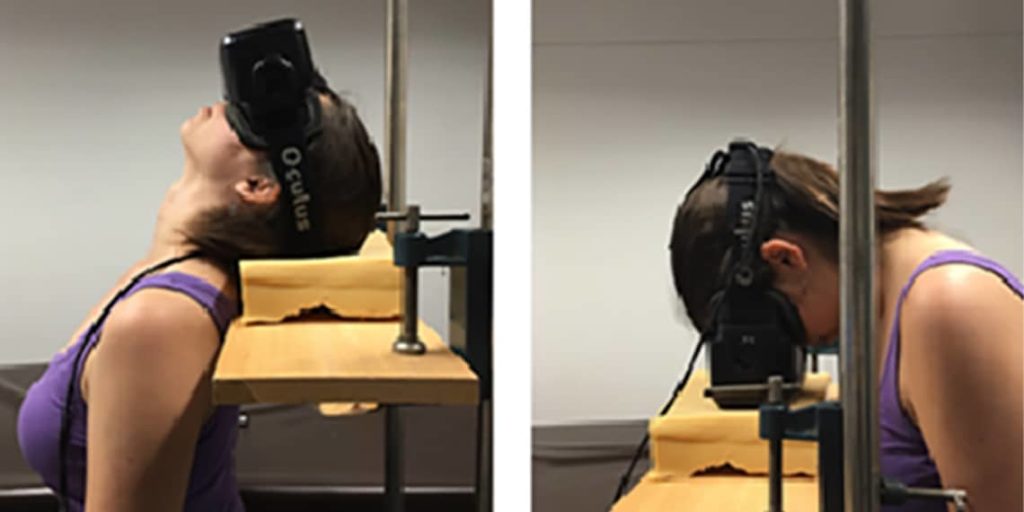
Visual reorientation illusion (VRI) is a phenomenon in which one’s perception of body positioning (e.g. standing vs. lying down) or motion (e.g., moving vs. static) disagrees with reality. It can be induced by tricking the brain with false sensory data: rotating a room 360º about a horizontal axis, for example, or tilting a room 90º with familiar objects (e.g. a lamp) whose orientation disagrees with gravity.
Beyond the purely scientific interest in understanding how differing and contrary signals are interpreted by the brain, being able to reliably produce (or combat) sensory illusions has practical applications in transportation and the future of immersive gaming and virtual experiences. In the present study, published in PLoS ONE, scientists from York University in Canada took a closer look at how the brain weighs contradictory sensory signals.
The series of three studies, involving a total of 72 participants, used supine (lying on one’s back) and supine-like (head tilted back), prone (lying face-down) and prone-like (head tilted forward), and standing positions to manipulate sensations of gravity, while a VR helmet provided corollary or contradictory visual stimuli, in the form of either a hallway (strong up-down signals) or starfield (ambiguous up-down signals).
See the full story here: https://www.psypost.org/2021/05/virtual-reality-study-sheds-light-on-what-happens-when-your-brain-cant-tell-which-way-is-up-or-down-60874
Your Disney World selfies just got so much cooler
Disney Parks and Snap (the parent company of Snapchat) announced a new partnership that will allow people to take selfies with virtual Disney characters and decorations.
- The new partnership allows guests to use the My Disney Experience app to take photos that include augmented reality technology.
- Disney Parks said in a blog post: “Mickey and Minnie will be right beside you in Snapchat with their playful expressions and gestures. They can even give you a hug!”
See the full story here: https://www.deseret.com/entertainment/2021/5/24/22447323/disney-world-selfies-snap
/cdn.vox-cdn.com/uploads/chorus_image/image/69333091/AP20332570049737.0.jpg)
California is finally confronting its history of slavery. Here’s how.
The newest monument to Black history in Los Angeles is small enough to fit in your pocket. Rather than a physical structure, the monument is projected onto the landscape through the viewer’s phone using augmented reality (A.R.) technology. Created by artist Ada Pinkston, the work celebrates the life of Biddy Mason, a formerly enslaved woman who helped build modern Los Angeles through her philanthropy and entrepreneurship.
The Biddy Mason A.R. installation is one of several new initiatives to transform California’s commemorative landscape. Often called the “city of the future,” Los Angeles is now investing heavily in its past. Those efforts — cooperative ventures between a responsive local government and community leaders — offer a blueprint for other cities and states to follow as they, too, confront their troubled histories.
Beginning with the Gold Rush, hundreds of White Southerners raced westward. Many traveled with enslaved people who were forced on the journey. Although California outlawed human bondage in 1850, state courts upheld Southerners’ slaveholding. According to historian Stacey Smith, 1,500 African Americans — as well as an untold number of Native Americans — labored in bondage in California before the Civil War.
Los Angeles has created a blueprint for positive change. A responsive local government, united with expertise and support from multiple community-based activists, has begun to reimagine the memorial landscape. Whereas other efforts have been stymied by heavy-handed policies and legal challenges, the initiatives in Southern California remain locally-focused and achievable.
See the full story here: https://www.washingtonpost.com/outlook/2021/05/24/california-is-finally-confronting-its-history-slavery-heres-how/

This new cryptocurrency has people buzzing — its market value is at $35 billion in just 3 days
[PhilNote: Why didn't they release their security audits that have been completed 3 days ago when they launched?!?!?!? Let's assume they aren't 'editing' them. This does not yet pass the hype test.]
Internet Computer, a cryptocurrency that just launched on Monday now has a market value of about $35.8 billion, according to CoinMarketCap, trading at around $289.
On Monday, the market value skyrocketed to over $90 billion (at a price of around $731), but within minutes the price fell, hitting as low as $18 billion (priced at about $146).
The cryptocurrency’s founders, the Dfinity Foundation, intend for Internet Computer to become, in effect, a decentralized version of the internet.
The Internet Computer blockchain uses smart contracts — just as the Ethereum blockchain does — which can power a number of applications and platforms.
"...Gates include, but are not limited to, the DFINITY Foundation releasing all related source code that is not yet in the public domain, the release of vast quantities of technical and design information pertaining to ICP (Internet Computer Protocol) including full descriptions of the Chain Key cryptography and protocol math that makes the Internet Computer network possible; security audits and stress tests being successfully passed...
See the full story here: https://www.cnbc.com/2021/05/12/new-cryptocurrency-internet-computer-hit-billions-in-value-after-debut.html?fbclid=IwAR3b2Yi6oJFAde8bdGoFL3NmVnVemzWFJz32o6GIMhnoGhrVuOPuTgHm-FQ