MIT artificial intelligence tech can generate 3D holograms in real-time
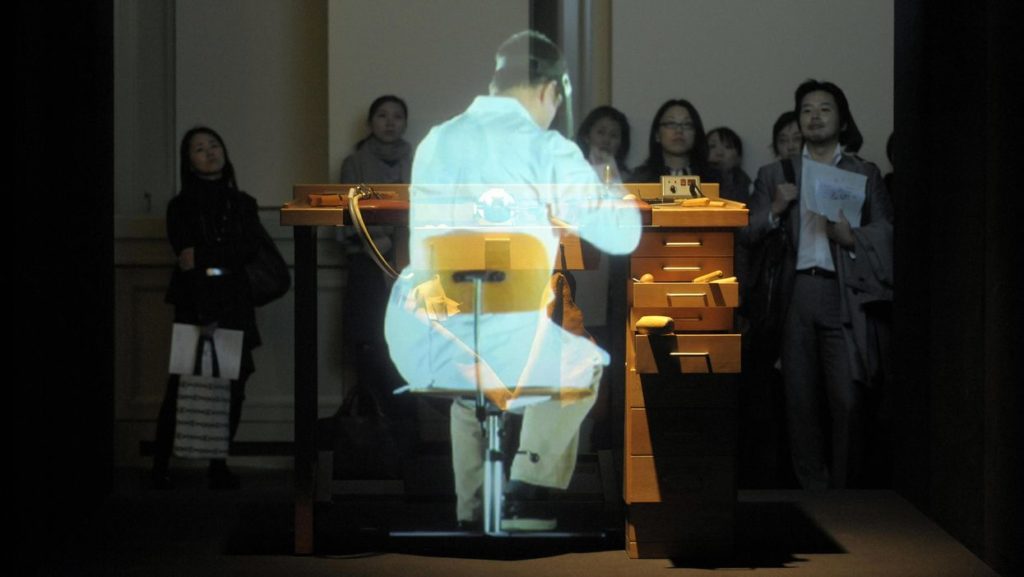
Now, MIT researchers have developed a new way to produce holograms almost instantly — and the deep learning-based method is so efficient that it can run on a laptop in the blink of an eye, the researchers say.
Shi believes the new approach, which the team calls "tensor holography," will finally bring that elusive 10-year goal within reach.
...a hologram encodes both the brightness and phase of each light wave. That combination delivers a truer depiction of a scene's parallax and depth.
...
Shi's team took a different approach: letting the computer teach physics to itself.
They used deep learning to accelerate computer-generated holography, allowing for real-time hologram generation. The team designed a convolutional neural network — a processing technique that uses a chain of trainable tensors to roughly mimic how humans process visual information.
In mere milliseconds, tensor holography can craft holograms from images with depth information — which is provided by typical computer-generated images and can be calculated from a multicamera setup or LiDAR sensor (both are standard on some new smartphones).
This advance paves the way for real-time 3D holography. What's more, the compact tensor network requires less than 1 MB of memory. "It's negligible, considering the tens and hundreds of gigabytes available on the latest cell phone," he says.
The research "shows that true 3D holographic displays are practical with only moderate computational requirements," says Joel Kollin, a principal optical architect at Microsoft who was not involved with the research.
Currently, most affordable consumer-grade displays modulate only brightness, though the cost of phase-modulating displays would fall if widely adopted.
The work was supported, in part, by Sony.
See the full story here: https://bigthink.com/technology-innovation/3d-holograms
Google Envisages A GPT-3-like Query System, Without Search Results
A new paper from four Google researchers proposes an ‘expert’ system capable of authoritatively answering users’ questions without presenting a list of possible search results, similar to the Q&A paradigm that has come to public attention through the advent of GPT-3 over the past year.
The paper, entitled Rethinking Search: Making Experts out of Dilettantes, suggests that the current standard of presenting the user with a list of search results in response to an inquiry is a ‘cognitive burden’, and proposes improvements in the ability of a natural language processing system (NLP) to provide an authoritative and definitive response.
Under the proposed model of an ‘expert’, cross-domain oracle, the thousands of possible search result sources will be baked into a language model instead of being explicitly available as an exploratory resource for users to evaluate and navigate for themselves. Source: https://arxiv.org/pdf/2105.02274.pdf
The paper, led by Donald Metzler at Google Research, proposes improvements in the type of multi-domain oracle responses that can currently be obtained from deep learningautoregressive language models such as GPT-3. The main improvements envisaged are a) that the model would be capable of accurately citing the sources that informed the response, and b) that the model would be prevented from ‘hallucinating‘ responses or inventing non-existent source material, which is currently an issue with such architectures.
Multi-Domain Training And Capabilities
Additionally, the proposed language model, characterized in the paper as ‘A Single Model for all Information Retrieval Tasks’, would be trained on a variety of domains, including images and text. It would also need an understanding about the provenance of knowledge, which is lacking in GPT-3 style architectures.
‘To replace indexes with a single, unified model, it must be possible for the model itself to have knowledge about the universe of document identifiers, in the same way that traditional indexes do. One way to accomplish this is to move away from traditional LMs and towards corpus models that jointly model term-term, term-document, and document-document relationships.’

In the image above, from the paper, three approaches in response to a user inquiry: left, the language models implicit in Google’s algorithmic search results have chosen and prioritized a ‘best answer’, but have left it as the top result of many. Center, a GPT-3 style conversational response, which speaks with authority, but does not justify its claims or cite sources. Right, the proposed expert system incorporates the ‘best response’ from the ranked search results directly into a didactic answer, with academic-style footnote citations (not depicted in the original image) indicating the sources that inform the response.
See the full story here: https://www.unite.ai/google-envisages-a-gpt-3-like-query-system-without-search-results/
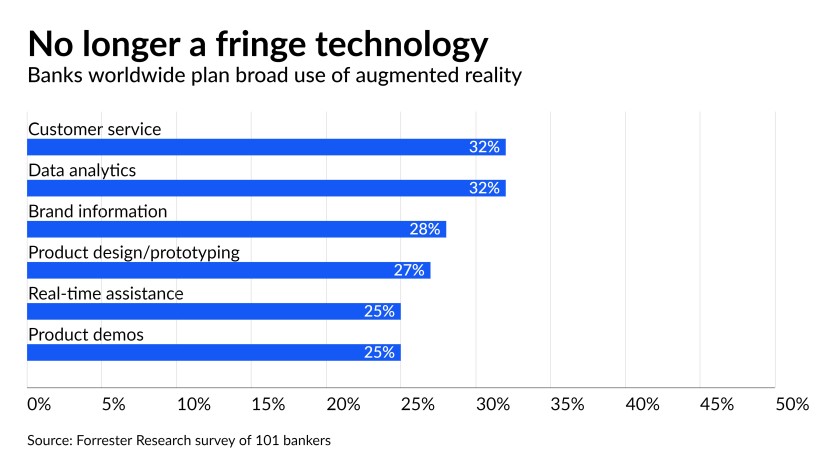
Augmented reality produces real results for Ally Bank
See the full story here: https://www.americanbanker.com/news/augmented-reality-produces-real-results-for-ally
AI Expert Charles Simon Publishes Guide for Creating Artificial General Intelligence
“The Brain Simulator II software is now robust enough to need a full explanation which not only documents the program, but explains the background and philosophy behind it and the direction of future development,” notes Simon. “I wrote the companion book to provide neuroscientists, cognitive scientists, and programmers interested in AGI or spiking AI software with everything they might need to build a system that can learn about object permanence, spatial relationships, and time/causality, and ultimately help AI to become AGI.”
Highlighting the features that set Brain Simulator II apart from other AI software – including user and programming interfaces which allow users to examine and modify the network’s internal workings in real time, a powerful spiking neuron engine that is a biologically plausible emulation of the brain, and more than 50 modules for performing a variety of AI tasks – Brain Simulator II: The Guide for Creating Artificial General Intelligence contains chapters which describe:
- Neuron simulation models currently being implemented, and the distinction between biological neurons and traditional AI;
- Applications of neurons that work together to perform digital logic functions;
- Modules which allow programmers to create custom computer code for any cluster of neurons; and
- The Universal Knowledge Store (UKS), a set of modules which can store any kind of information and create relationships between different types of information.
See the full story here: https://www.prweb.com/releases/ai_expert_charles_simon_publishes_guide_for_creating_artificial_general_intelligence/prweb17910195.htm
AT&T Adds Augmented Reality Statistics to the Chicago Bulls Mobile App
AT&T is working with the Chicago Bulls and Nexus Studios to roll out a new fan experience within the Chicago Bulls app that gives fans the ability to see immersive 3D stats during Chicago Bulls’ games.
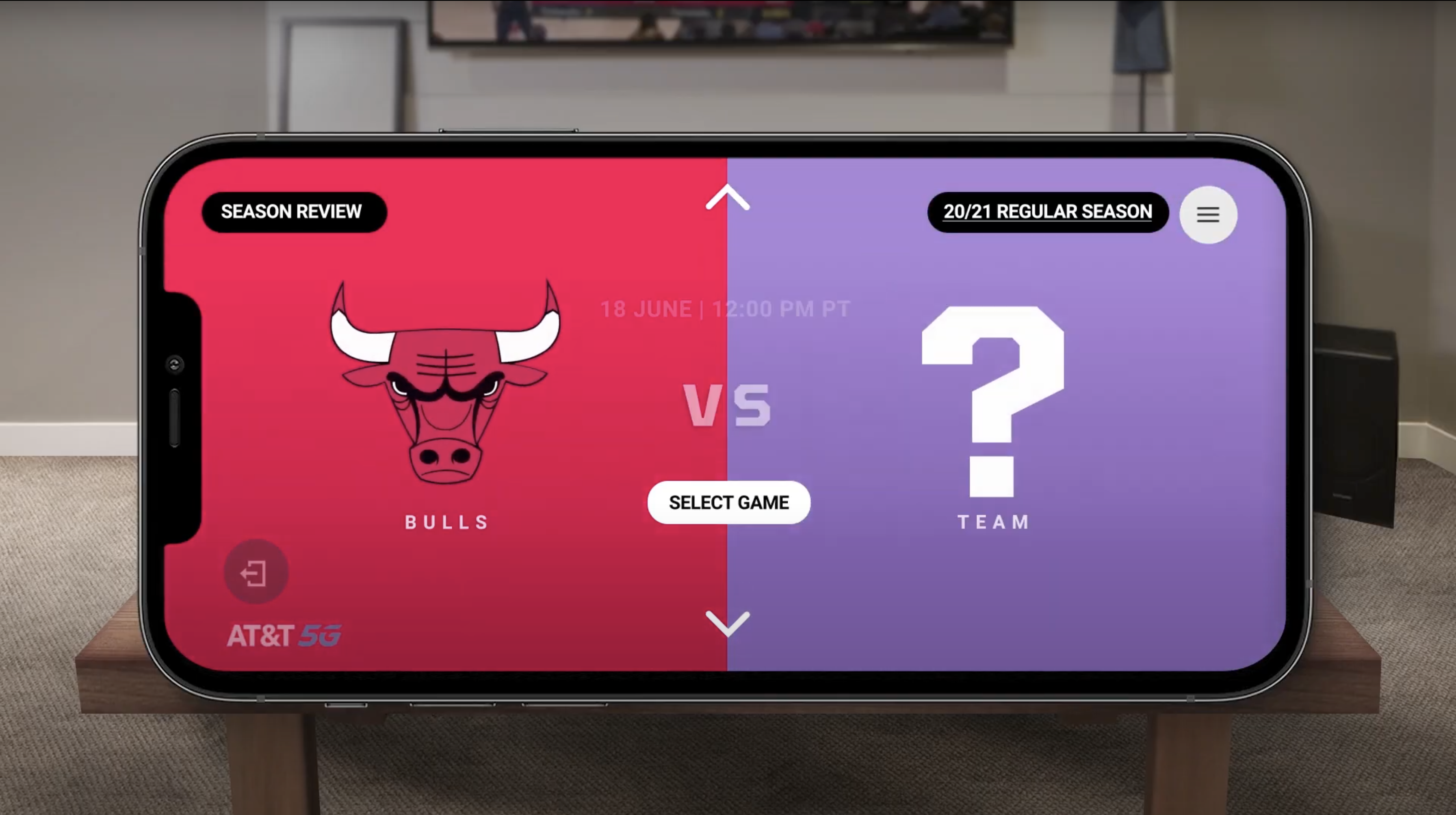
With AT&T StatsZone, Bulls fans can view their favorite team and player stats of current and past games in a customized AR view on their smartphone. In addition, they will be able to send and share clips of their favorite stats highlights and milestone celebrations from the game to their friends, family and on social media.
See the full story here: https://www.sportsvideo.org/2021/05/05/att-adds-augmented-reality-statistics-to-the-chicago-bulls-mobile-app/