MIT Taught Self-Driving Cars to See Around Corners with Shadows
 The new MIT system is simpler because it just looks for subtle changes in light and shadow on the ground that indicate another vehicle is approaching.
This work comes from MIT’s famous Computer Science and Artificial Intelligence Laboratory (CSAIL). The team thinks this approach to monitoring the environment around a vehicle could be the equivalent of x-ray vision for cars. Whereas the LIDAR used for object mapping in current self-driving cars has high resolution and collects more data than a visible light camera, it can only objects that are directly visible. A shadow, however, might be enough to trim as much as half a second off the car’s reactions. That could be the difference between a major accident and a near miss.
ShadowCam uses a sequence of four video frames from a camera pointed at the region just ahead of the car.
See the full story here: https://www.extremetech.com/extreme/301073-mit-taught-self-driving-cars-to-see-around-corners-with-shadows
Spreading the Love of Classical Music Through Virtual Reality
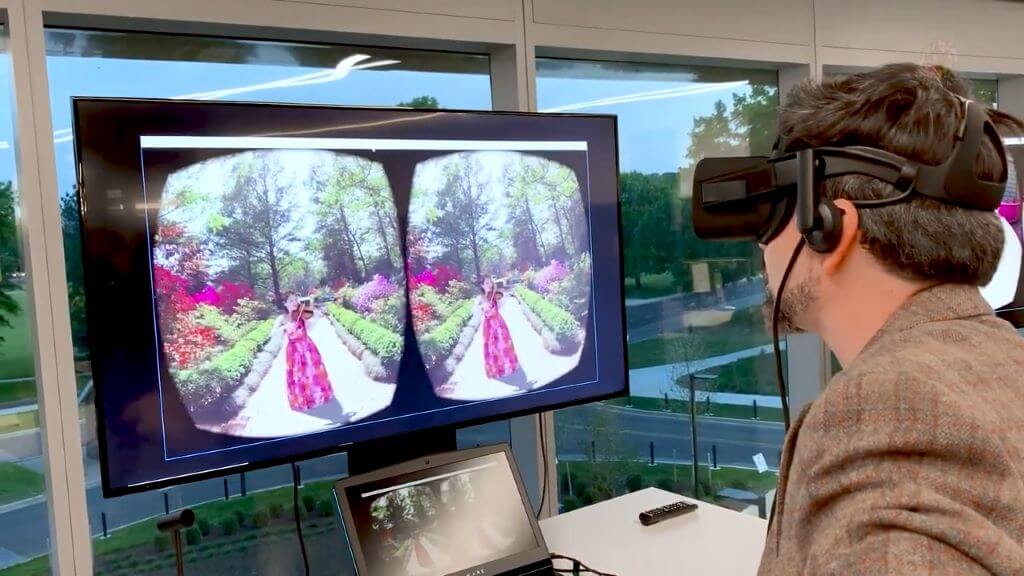 PlayStation VR made a Joshua Bell VR experience for music lovers and tech enthusiasts. Owners must use a VR headset and any pair of headphones to indulge in the full experience. Once set up, the app takes users to the Lyndhurst hall in London. There, Bell performs the Hungarian Dance No. 1 by Brahms, along with pianist Sam Haywood.
Developers leveraged binaural audio processing technology, as well as directional surround sound to make everything come to life. In other words, users will hear the sound in exquisite detail the closer they move to Bell. If they step back, they will experience the hall’s natural reverb.
Owners of a PlayStation headset can download the VR experience for free.
How VR Is Transforming Classical Music
Another up and coming VR application is the Four Strings Around the World project. Featuring Romanian violinist, Irina Muresanu, the app takes its audience around the world as she plays beautiful melodies with her violin.
Through the app, users can have a one-on-one lesson with Muresanu. They can see and observe the movement of her hands and her bow arms in great detail.
See the full story here: https://arpost.co/2019/10/30/spreading-love-classical-music-virtual-reality/
(Vancouver) Tetsuro Shigematsu’s new play explores lives swallowed up by the lure of virtual reality
 In Kuroko, a co-production between the Cultch and Vancouver Asian Canadian Theatre, Maya (Kanon Hewitt) is a young woman who has secluded herself in her room for the better part of six years. But when a mysterious stranger challenges her to help save her dying father, she is forced to come to terms with the outside world.
Rather than delve too deeply into the latest developments in virtual reality tech, which would have dated the play (“It would be the equivalent of doing a show about MySpace,” he said), he was more fascinated by the phenomenon of hikikomori — people, like Maya, who opt out of society and retreat into their rooms.
“We realized that even if you’re watching what someone is doing in virtual reality on a screen, it’s still a solitary experience to behold. So we decided to go completely analog — using theatrical conventions of gestures and no masks or goggles at all, and letting audience members use their imagination.”
See the full story here: https://vancouversun.com/entertainment/local-arts/tetsuro-shigematsus-new-play-explores-lives-swallowed-up-by-the-lure-of-virtual-reality
Moving-tolerant Augmented Reality Surgical Navigation System using Autostereoscopic 3D Image Overlay
[PhilNote: they seem to be inventing a specialized system at the same time the AR hardware industry is developing a general purpose device that can do the same thing; ex. Oculus Quest.]
 Augmented reality (AR) surgical navigation systems based on image overlay have been used in minimally invasive surgery (MIS). However, conventional systems still suffer from a limited viewing zone, a shortage of intuitive three-dimensional (3D) image guidance and can’t be moved freely. To fuse the 3D overlay image with the patient in situ, it is essential to track the overlay device while it is moving. A direct line-of-sight should be maintained between the optical markers and the tracker camera. We propose a moving-tolerant AR surgical navigation system using autostereoscopic image overlay, which can avoid the use of the optical tracking system during the intraoperative period. The system captures binocular image sequences of environmental change in the operation room to locate the overlay device, rather than tracking the overlay device directly. Therefore, it is no longer required to maintain a direct line-of-sight between the tracker and the tracked devices. The movable range of the system is also not limited by the scope of the tracker camera. Computer simulation experiments demonstrate the reliability of the proposed moving-tolerant AR surgical navigation system. We also fabricate a computer-generated integral photography (CGIP)-based 3D overlay AR system to validate the feasibility of the proposed moving-tolerant approach. Qualitative and quantitative experiments demonstrate that the proposed system can always fuse the 3D image with the patient, thus increasing the feasibility and reliability of traditional 3D overlay AR surgical navigation systems.
See the full story here: https://jbhi.embs.org/2019/10/30/moving-tolerant-augmented-reality-surgical-navigation-system-using-autostereoscopic-3d-image-overlay/
Why AI Needs Human Input (And Always Will)
 The reality is that we are still far from achieving generalized AI that is functionally equivalent to the human mind. As the cofounder and CEO of a customer support automation platform that helps enterprises launch and train virtual agents, I've realized that whether the first generalized AI is born a year or 100 years from now, AI will always require human input and expertise — technical and otherwise — to operate at its full potential in a way that's ethical, responsible and safe.
Below, we'll take a look at some examples of how AI relies on human input across a variety of established and emerging applications and explain why even the smartest AI will still require human assistance.
Social media: Humans course-correct for algorithmic extremism.
Unfortunately, according to a report published by Social Media Today, these algorithms were found to have helped instigate political divisions by favoring divisive content to drive engagement.
Medicine: Combining human and machine intelligence.
Self-driving cars: AI handles corners, while humans handle corner cases.
See the full story here: https://www.forbes.com/sites/forbestechcouncil/2019/10/30/why-ai-needs-human-input-and-always-will/#8c8acf75ff7d
Dark mode is everywhere. Is it really better for you?
 Design types are notorious for wearing black (guilty as charged) and they aren’t alone: Black was the most popular color in womenswear in 2017, taking up 36% of the market according to the retail technology company Edited. The popularity of dark hues has even crossed the boundaries of fashion and made its way into UX and UI design, with a slew of popular apps and programs introducing “dark mode” options that reverse the reigning color scheme of the web.
See the full story here: https://www.fastcompany.com/90421232/dark-mode-is-everywhere-but-is-it-really-better
Shopping mall to focus on Artificial Intelligence and technology
 A shopping mall, said to be focussing on Artificial Intelligence and state-of-the-art technology, is to be built in Kuwait.
Tamdeen Group has announced the tech-equipped Al Khiran Hybrid Outlet Mall, through its subsidiary Tamdeen Pearl, which it describes as ‘a spectacle in design and offering.’
The developer will invest in ‘major experience-based components’ like Artificial Intelligence and technology-driven entertainment as part of the project, although currently no further details are available.
See the full story here: https://www.intelligentcio.com/kuwait/2019/10/29/shopping-mall-to-focus-on-artificial-intelligence-and-technology/
Intel partnering with Caesars, UNLV at Las Vegas innovation hub
 UNLV and Caesars Entertainment Corp.’s soon-to-open Black Fire Innovation research and technology hub has caught the eye of technology giant Intel.
On Tuesday morning, Caesars announced Intel as a new partner for the facility, set to open in January. The California-based company will provide technology and computing resources, along with research and internship opportunities for students and other partners, according to a Tuesday morning press release from Caesars.
The facility’s core research focus is to enhance the customer experience in the hospitality industry, using emerging technologies such as blockchain, data science, robotic automation, artificial intelligence and the internet of things.
Rick Hack, head of media and entertainment partnerships at Intel, said the hub’s focus resonated with the business.
“Intel’s relationship with Black Fire was important to us because it covered the area of esports, AI, immersive media, hospitality,” he said in the video.
See the full story here: https://www.reviewjournal.com/business/casinos-gaming/intel-partnering-with-caesars-unlv-at-las-vegas-innovation-hub-1881088/
Shanghai subway to trial augmented reality smart glasses to ease passenger flow during China International Import Expo
 The glasses are expected to help manage passenger flows between the Xujing East station in west Shanghai and the nearby National Exhibition and Convention Centre from next Tuesday to Saturday, online news site Thepaper.cn reported on Tuesday.
The smart glasses are fitted with cameras that are directly linked to the station’s central command platform, and will also make it easier for staff to locate and control sudden incidents, the report said.
Meanwhile, police forces in other parts of China – including Gansu, Henan and Yunnan provinces – have also been trying out AR smart glasses to help identify suspected criminals in public.
At least seven hit-and-run fugitives were caught by the technology, as well as 26 cases of identity fraud.
See the full story here: https://www.scmp.com/news/china/society/article/3035408/smart-glasses-ease-visitor-flows-shanghai-subway-china
8th Wall opens the floodgates for augmented reality on the web with its cloud-based WebAR authoring and hosting platform
 8th Wall, the company that brought frictionless augmented reality (AR) to the world by harnessing the power of the web, announced today the release of its cloud-based authoring and hosting platform. This groundbreaking platform closes the loop on AR production and removes the barriers for developers by providing a unified in-browser solution to create and host WebAR projects. In doing so, 8th Wall is opening the floodgates for brands and organizations to quickly launch sophisticated WebAR experiences, continuing to deliver on its mission to make sure augmented reality is for everyone.
8th Wall has powered WebAR activations for brands such as Sony Pictures’ Spider-Man, Miller Lite, British Gas, Heineken, Swiss Airlines, Porsche, Red Bull, Time Magazine, LEGO and Ally + MONOPOLY. Its in-browser AR experiences require no app downloads, removing the friction for users and providing brands and organizations with massive reach and engagement. In fact, AR Insider estimates that WebAR has the ability to reach nearly twice as many smartphones as native AR apps, with a global market of over 2.97 billion compatible devices. And, according to 8th Wall data, 50% of users spend greater than 2 minutes interacting within a single WebAR activation.
The 8th Wall cloud-based authoring and hosting platform is available today for Agency and Business account holders providing them with the ability to:
- Create SLAM and image target-enabled WebAR experiences using 8th Wall’s fully featured text editor with out-of-the-box support for the most popular web frameworks (React, Vue.js, A-Frame, Babylon.js and Three.js), developer keybindings and dark mode.
- Collaborate with multiple team members on one project from anywhere in the world and quickly view and resolve conflicts with an in-browser distributed version control system.
- Publish and host WebAR projects to different deployment states including a password-protected staging environment, all served globally on the edge for instantaneous and fast viewing of code updates.