 Rubin is a journalist at Wired and the author of Future Presence: How Virtual Reality Is Changing Human Connection, Intimacy, and the Limits of Ordinary Life, out today from HarperCollins. The Verge spoke to Rubin about VR intimacy, its social powers and downsides, and why VR porn is surprisingly quaint
Jaron Lanier, who famously popularized the term “virtual reality” and was one of the early pioneers of VR as a consumer idea, called it “the conversion moment,” or when people start believing in the virtual reality world they’re in. Your rational brain always knows that stuff is outside the headset, but the reptilian brain doesn’t. That unlocks everything we talk about in the book.
I can almost guarantee you that a cocktail party in VR is invariably more fun and more rewarding than a cocktail party in real life, and maybe that would be my answer: let’s go do this in VR.
To bring up Jaron Lanier again, I once asked him the very best thing he could imagine in VR, and what he said was, “Performance artists who, rather than creating art, they create reality and they do it in real time.”
I bring that up as an example of a thing that doesn’t have a precedent. There’s a role for AI in this, too.
See the full story here: https://www.theverge.com/2018/4/17/17242326/virtual-reality-vr-peter-rubin-future-presence
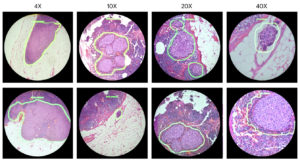 Google has shown in the past that a neural network can accelerate diagnosis of cancer in digital images, but most pathologists are using compound light microscopes to examine slides. The solution was the Augmented Reality Microscope. With this system, Google’s AI sees an image in the microscope in real time along with the doctor. Then, it overlays analysis on top of that image.
The first piece of the puzzle was getting a neural network trained on what is and is not cancer. This is another convolutional neural network like the one used to isolate voicesand spot planets. Working with pathologists, Google Research accumulated thousands of histological images. The result was a pair of cancer detection algorithms: one detects breast cancer metastases in lymph nodes, and the other spots prostate cancer. They work at magnifications between 4x and 40x.
The goal is not to replace the pathologist — you probably don’t want to trust your entire cancer screening to a machine just yet. That’s why the neural network is tied to the ARM system. It’s like an instant second opinion.
See the full story here: https://www.extremetech.com/extreme/267614-google-builds-augmented-reality-microscope-to-detect-cancer
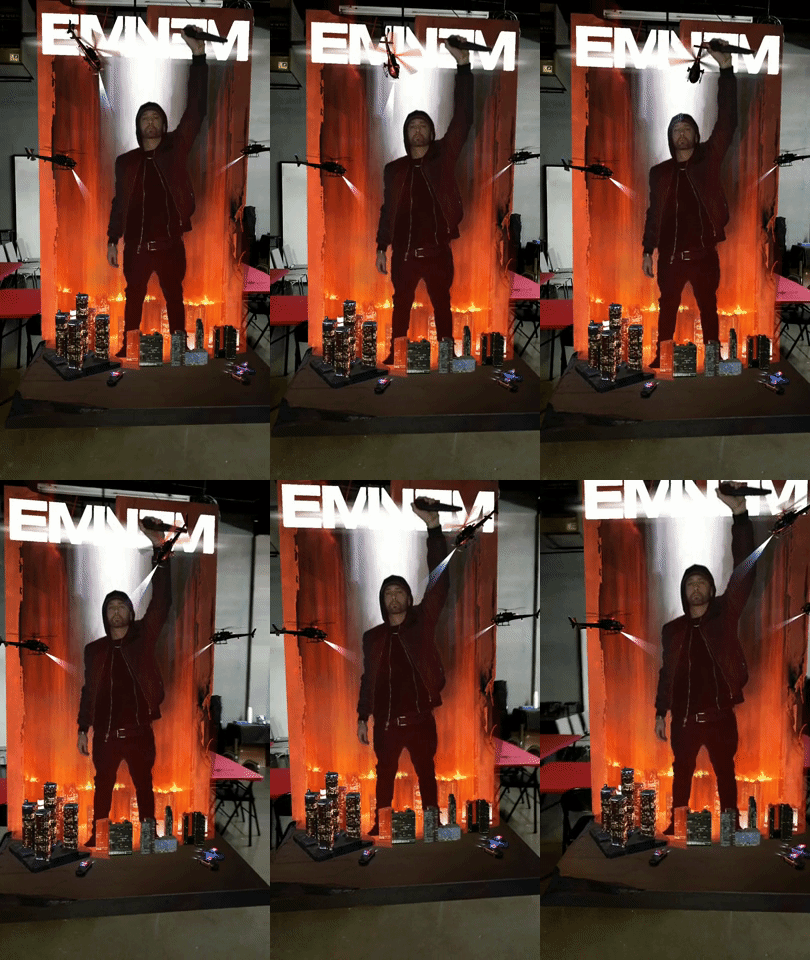
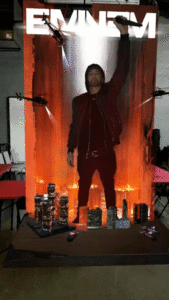 The app, crafted using ARKit and ARCore, offers a pair of experiences involving the artist accompanied by snippets of his music. The first imagines a super-sized Eminem towering over a skyline, with helicopters surrounding him as if he were King Kong. The second experience opens a virtual portal to a stage in the desert.
In addition, an AR animation featuring Marshall Mathers acting as perhaps the worst spokesperson for a brand is unlocked by scanning the marvelously meta Mom's Spaghetti logo for the pop-up restaurant the artist brought to Coachella. "It's not that good," says Slim Shady after virtually vomiting plates of pasta.
Another AR experience, ominously titled "Stan's Basement," will arrive in a future update. The app also enables some AR content that is only available during live performances.
See the full story here: https://mobile-ar.reality.news/news/coachella-eminem-hit-high-notes-with-augmented-reality-mobile-apps-0184178/
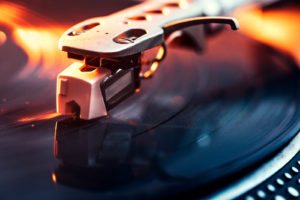
A close up shot of a running record player spinning out some music, dramatically lit with orange light. Horizontal with copy space.
Specifically, converting analog audio information into a digital, 3D topographic map of the music, and then etching that into a platter with light. According to Pitchfork, this process will result in around 40 percent longer playing times per side, 30 percent more amplitude and will offer better sound quality overall. It'd also sidestep the chemicals typically used in the record-making process.
That's right, your existing turntable will play these and your collection of vintage records. It probably won't stop labels from putting out new versions of their classic catalogs at an even higher price, however.
See the full story here: https://www.engadget.com/2018/04/12/high-definition-vinyl/
 Getting updates on your bank account in augmented reality. Credit scores built on blockchain. Payment requests that involve scanning would-be recipients with facial recognition technology.
But with patenting, there is no guarantee that an idea will come to fruition. Death also said that there is never a “silver-bullet patent,” and that it is “clusters and groups” of patents that show where an organization may be focused.
According to the United States Patent and Trademark Office’s website, its backlog of yet-to-be-examined patent applications was 540,677 filings long as of February.
See the full story here: http://business.financialpost.com/news/fp-street/from-blockchain-to-augmented-reality-canadas-big-banks-aim-to-patent-the-future-of-finance
Google is opening up its VR180 video format to any developer or tech pro who wants to experiment with it.
For those who don’t follow the virtual reality (VR) industry that closely, VR180 is a format that allows creators to record immersive videos in 4K resolution. On the software side, components for immersive video include the Spherical Video Metadata V2 standard, along with the Camera Motion Metadata Spec; for photos, there’s the VR Photo Format that Google originally developed for the Cardboard Camera.
Google has released details about the platform to GitHub and the Google Developer website. If you’re curious about VR and/or photography, its information is well worth checking out.
In contrast to Facebook, HTC and Valve, all of which have pursued VR from the angle of high-cost headsets (the Oculus Rift, in the case of Facebook; the Vive, in the case of HTC and Valve), Google has long focused on “democratizing” VR through ultra-cheap headsets and a more open developer ecosystem. In this fashion, the search-engine giant is following the playbook it pioneered with Android, which it gave away free to phone and tablet manufacturers. In theory, a free or low-cost platform will grow very quickly, allowing its creator to seize massive chunks of market-share (albeit at the expense of profits).
See the full story here: https://insights.dice.com/2018/04/13/google-opening-up-vr180-virtual-reality-format-to-devs/
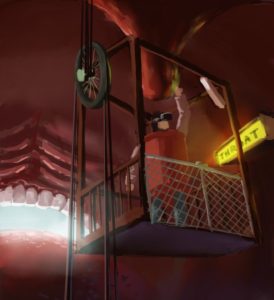 Metamucil, Australia’s number one fibre supplement brand, has taken a step into virtual reality (VR) to help education views on the journey their pills take through the digestive system and how they keep things ticking over smoothly.
The experience, titled Gutland, was shown off as a first-of-its-kind pop-up event hosted at the Darling Harbor, Sydney yesterday.
What sets Metamucil’s Gutlandexperience apart is that you can physically touch everything you see in the VR world. Everything you place your hands on real world is exactly matched by virtual objects inside Gutland.
See the full story here: https://www.vrfocus.com/2018/04/take-a-vr-trip-through-the-human-digestive-system-in-gutland/
 Blockchain enables accurate scarcity along with the true ownership of creatures and assets, making it a perfect platform for gaming. By using decentralised ledger, games enable gamers to battle, train and trade on a whole new level.
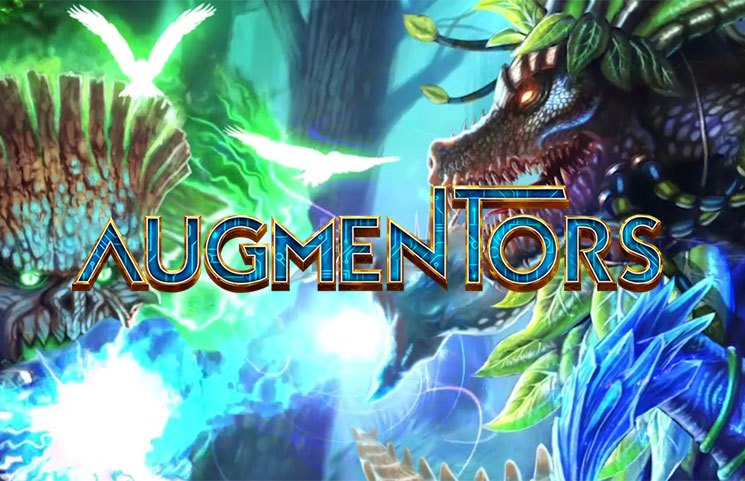
With the advent of Augmentors, a new dimension of gaming has arrived. It’s where reality and illusion collide as you summon your creatures into the real world to do bidding.
Augmentors DTB ICO Blockchain Augmented Reality Databits Details
Augmentors had raised $1 million USD(895 BTC) during the 30- day token sale, which ended on February 2017. At the time of the sale, it was the most successful token sale ever conducted by a mobile video game project and it was the first token sale that was conducted in South Africa.
The primary aim of this token, $DTBT, is to align the interest of the Augmentors business, the backers, the players and all participants in the network. The system uses Databits as the in-game currency, Databit Tetheres($DTBT). The $DTBT are locked to $DTB at a fixed ratio and. $DTBT are used in the internal virtual economy and in this economy, players will require $DTBT to utilize different game features. This means that the Augmentors business is highly incentivized to stabilize and grow the value of the network and $DTB can be traded into and out of $DTB.
See the full story here: https://bitcoinexchangeguide.com/augmentors-game-ico-dtb-token/
 The brand has installed its new AR (Augmented Reality) hotspots at key points around its shops for the next two weeks, and by downloading the corresponding app, customers are able to see virtual models showcasing the new Studio collection.
See the full story here: https://www.telegraph.co.uk/fashion/style/will-zaras-new-augmented-reality-experience-change-way-shop/
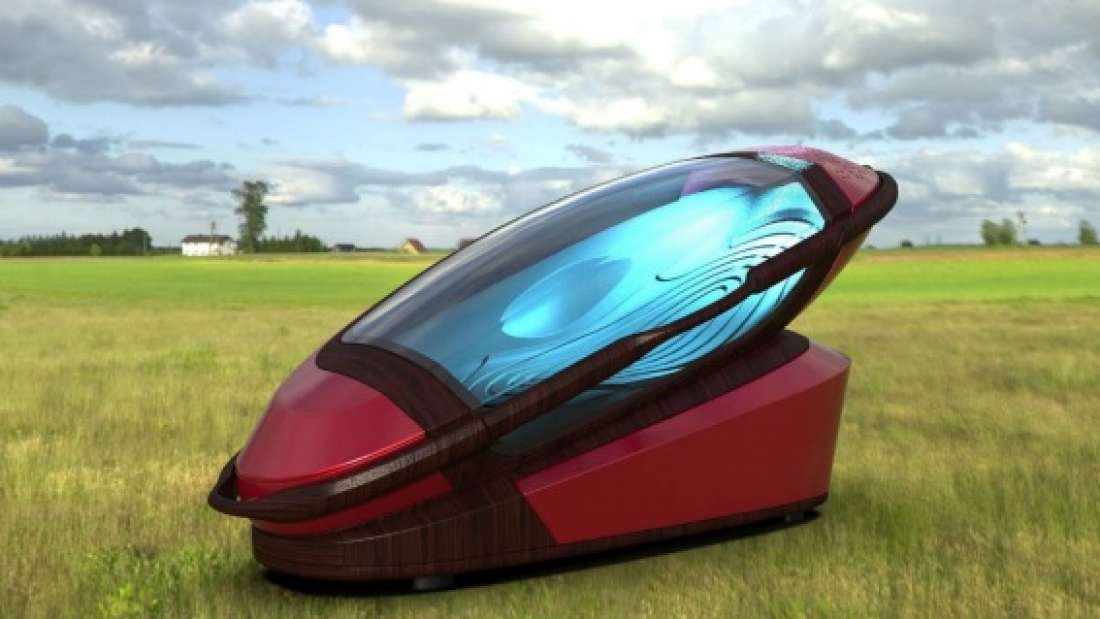
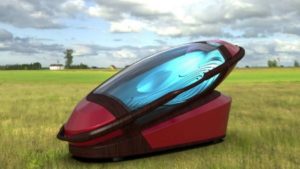 You can try it out for yourself – at least, in virtual reality – by stepping inside a full-size depiction of the euthanasia capsule. VR glasses give the user a glimpse into how the death machine operates.
The Sarco will sit on a generator that uses liquid nitrogen that, when released, will bring down the level of oxygen in the capsule to induce hypoxia. The brain relies on oxygen to function. When put in environments with low levels of oxygen, the body slowly begins to shut down, resulting in confusion, increased heart rate, rapid breathing, shortness of breath, sweating, and wheezing. In the Sarco, however, Nitschke says death will have “style and elegance” – within one minute, the user loses consciousness. Death shortly follows.
To activate the process, a person simply steps inside, lies down and, when ready, presses a button.
“A Sarco death is painless. There’s no suffocation, choking sensation or 'air hunger' as the user breathes easily in a low-oxygen environment. The sensation is one of well-being and intoxication,” wrote the company’s founder Philip Nitschke for Huffington Post.
The Sarco made headlines last year after the state of Victoria in Australia voted to legalize euthanasia. Media outlets deemed Nitschke the “Elon Musk of assisted suicide” and his death machine his “Tesla”.
See the full story here: http://www.iflscience.com/technology/experience-in-virtual-reality-what-it-feels-like-to-die-in-worlds-first-suicide-machine/