Ford, Universal Pictures Partner With Holoride For In-Car Virtual Reality Experience
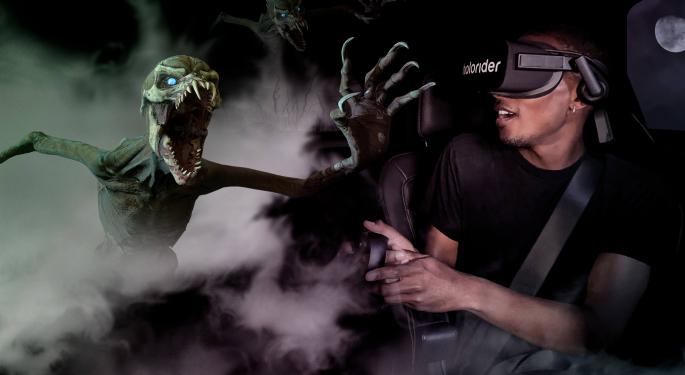 Ford Motor Company F 1.68% and Comcast Corporation CMCSA 2.36%-owned Universal Pictures have partnered with the company holoride to create an in-car virtual reality experience at Universal CityWalk.
The experience will be offered to guests for a limited time Oct. 14-Nov. 9, powered by technology from holoride, and set inside new 2020 Ford Explorer vehicles.
Once riders step inside the Explorers from a designated pickup location, they will don a VR headset and be joined by a "re-imagined, virtual Bride of Frankenstein" who's on a journey to deliver an important message to Frankenstein.
Riders will encounter virtual monsters and obstacles as part of a fully immersive VR experience with sound effects and visuals adapted to the vehicle's movements.
Holoride uses navigational data like travel route and time along with driving data from the vehicle — like steering, acceleration and stopping — to adapt the experience to match the movement of the vehicle, according to Thursday's announcement.
See the full story here: https://www.benzinga.com/news/19/10/14577182/ford-universal-pictures-partner-with-holoride-for-in-car-virtual-reality-experience
Disney taps Hitachi for smarter theme park magic
 Hitachi will enter a partnership with The Walt Disney Co. to provide artificial intelligence and analytics at the entertainment giant's theme parks, the Japanese technology group said Wednesday.
Hitachi Vantara, Hitachi's U.S. unit, has agreed to provide data analysis for both Disneyland and Disney World through the Lumada suite of internet of things tools. The partnership was announced at NEXT 2019, the data technology conference being held in Las Vegas.
Disney will be able to boost customer satisfaction by reducing maintenance times. Hitachi meanwhile will use the partnership as a jumpoff point to develop offshore markets in the IoT business. Right now, Lumada is 90% focused on domestic clients.
See the full story here: https://asia.nikkei.com/Business/Technology/Disney-taps-Hitachi-for-smarter-theme-park-magic
Disney to ‘Spellcheck’ Scripts for Gender-Bias Using AI Technology
 The Walt Disney Company will use a new artificial intelligence application to “spellcheck” scripts for gender bias in a new partnership with actress Geena Davis.

The collaboration, which was first reported by The Hollywood Reporter, will involve a new AI tool called “GD-IQ: Spellcheck for Bias,” which was developed at the University of Southern California Viterbi School of Engineering.
GD-IQ is intended to analyze the text of a script to determine the balance of male and female characters and whether the mix is representative of reality, according to the trade publication.
The tool also can discern the numbers of characters based on ethnicity, sexual orientation, and other groups.
Davis made the announcement at a recent gender inclusion summit in Auckland, New Zealand.
See the full story here: https://www.breitbart.com/entertainment/2019/10/09/disney-to-spellcheck-scripts-for-gender-bias-using-ai-technology/
An AI Pioneer Wants His Algorithms to Understand the ‘Why’
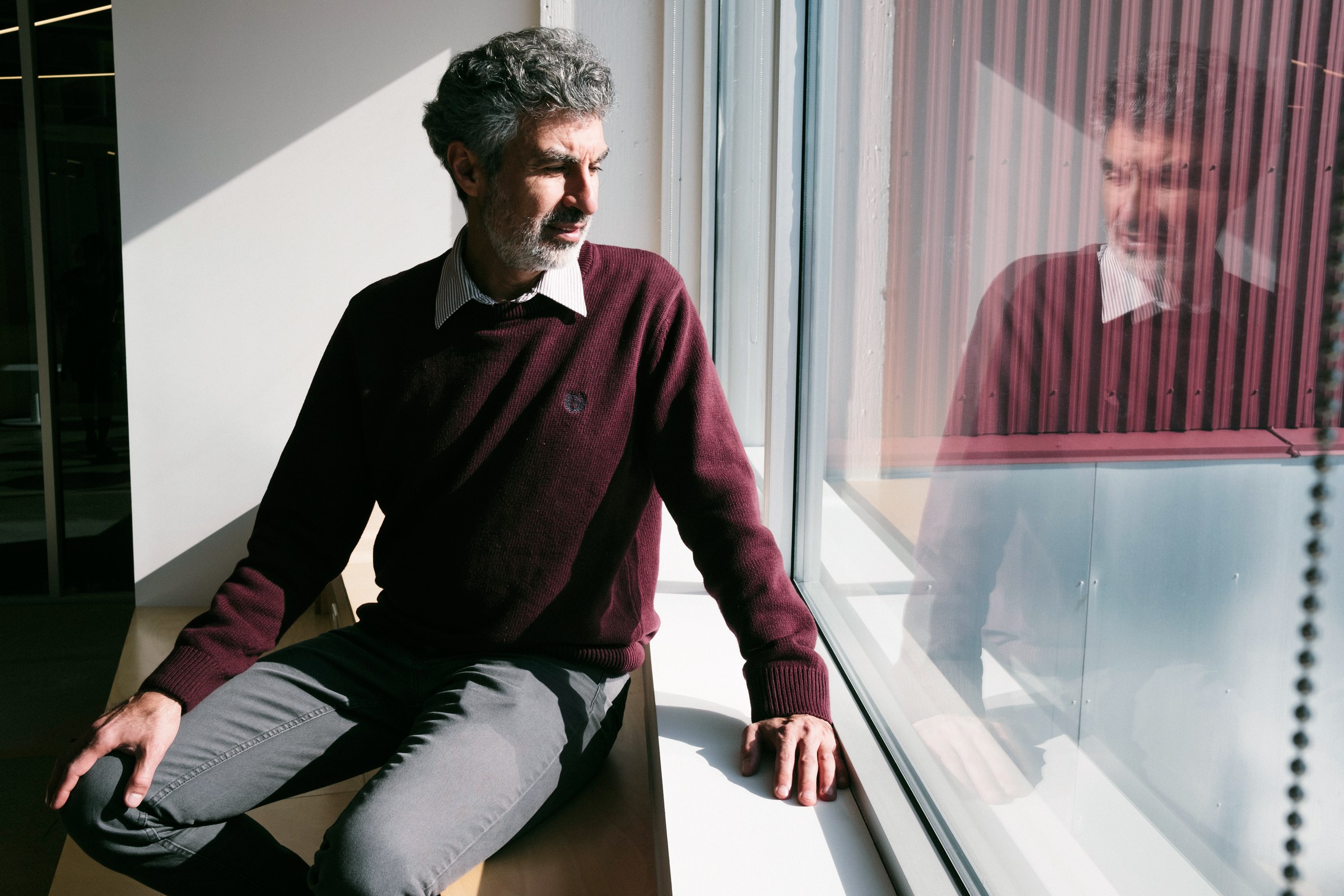 In March, Yoshua Bengio received a share of the Turing Award, the highest accolade in computer science, for contributions to the development of deep learning—the technique that triggered a renaissance in artificial intelligence, leading to advances in self-driving cars, real-time speech translation, and facial recognition.
Now, Bengio says deep learning needs to be fixed. He believes it won’t realize its full potential, and won’t deliver a true AI revolution, until it can go beyond pattern recognition and learn more about cause and effect. In other words, he says, deep learning needs to start asking why things happen.
“It’s a big thing to integrate [causality] into AI,” Bengio says. “Current approaches to machine learning assume that the trained AI system will be applied on the same kind of data as the training data. In real life it is often not the case.”
At his research lab, Bengio is working on a version of deep learning capable of recognizing simple cause-and-effect relationships. He and colleagues recently posted a research paperoutlining the approach.
Bengio has already transformed AI once. Over the past several decades, he helped develop the ideas and engineering techniques that unleashed the potential of deep learning, together with this year’s other Turing Award recipients: Geoffrey Hinton, of the University of Toronto and Google, and Yann LeCun, who works at NYU and Facebook.
See the full story here: https://www.wired.com/story/ai-pioneer-algorithms-understand-why/
Is Extended Reality The Future Of Digital Advertising?
 Verizon Media is another company that is pushing XR advertising forward. By combining quality AR with trusted inventory, the company is powering a new level of utility for the user and performance for the advertiser. Verizon has recently extended its XR offering off the back of a successful debut of AR on Yahoo Mail, which saw average dwell times of 60 seconds.
See the full story here: https://www.forbes.com/sites/solrogers/2019/10/08/should-brands-invest-in-xr-advertising/#e1a86211912e
New Halloween extravaganza features aerial acrobatics, virtual reality and more
Collaborating with Drexel University, Sanders and his creative team crafted a 45-minute virtual reality experience – one of the several attractions comprising “2nd Sanctuary.”

As participants dress in hazardous suits, they immerse in the Phantom Portal Virtual Reality, passing through a few locations throughout the church, including fictional phone booths and spas.
Whether transporting audiences to familiar Philadelphia sites or taking them up-close-and-personal to dancers, Sanders and his team shot various footage for the virtual reality portion for almost two months. The objective, he says, was focusing people in a singular direction within a 360 degree-perspective.
See the full story here: https://southphillyreview.com/2019/10/08/new-halloween-extravaganza-features-aerial-acrobatics-virtual-reality-and-more/